
I have learnt that in a multi-ethnic society where people of different races and religions live together, there is a need to be sensitive to one another's needs. Failure to understand and respect one another's way of life will affect the country in many ways. Similarly, in Singapore, there is a need to manage racial and religious sensitivities and promote tolerance and harmony. In addition, there is also the need to build a national identity by instilling a sense of belonging. To prevent division among people in the society, staying vigilant and active in identifying threats and strengthening social bonds are the responsibilities of the Singapore government and its people.
-Geraldine (:
Q1.How different are we?
Singapore is a multi-ethnic country. We are different by racial, cultural and religions backgrounds. Despite these differences, it is possible for people to live in peace and harmony.
Q2.What are the challenges of multi-ethnicity in Singapore?
In a multi-ethnic society like Singapore, issues such as race and religions can be used as conflict among the different groups. There are challenges like managing perceptions of different racial and religions groups and threats from external forces.
How racial issues could divide the people.
The lack of understanding among the racial groups can create suspicion and unhappiness among the people. This may lead to outbreaks of violence among racial groups. In 1964, Singapore experienced race riots which resulted in 36 people dead and 560 others injured.
In July 1964, during the celebration of Prophet Muhammad's birthday, a clash between a Chinese policeman and a group of Malay participants of the procession, turned into full-brown race riots over the next full days. These race riots cause damage to property as well as loss of lives. The race riots illustrated how easily the peace and harmony in Singapore can be broken.
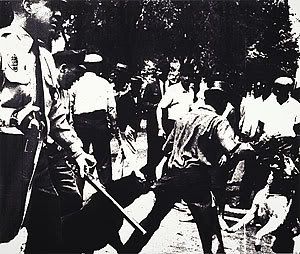
This is one of the picture captured during the race riots in 1964. [Click to zoom in]
How religious issues could divide the people.
Differences in religious beliefs and practice are also issues that can be used to create tension among the people in Singapore. This was illustrated by the Maria Hertogh riots in 1950. The outbreak of violence left behind destruction and loss of lives.
In the 1940s, a Dutch couple was imprisoned by the Japanese. That placed their daughter, Maria Hertogh, under the care of a Malay lady, Aminah. Maria was raised as a Muslim and at the age of 13, married a Malay teacher.
When her parents demanded that Maria be returned to them, a count trial followed. This court trial had wide media coverage and provoked much unhappiness among the Muslim community. The court decided to give custody to the Hertoghs, after much consideration.
The large crowd outside the court felt that the British legal system was unfair to Muslims. This sparked off anger towards the European and Eurasian communities which resulted in the outbreak of riots.The riots showed that if religions issues are not handed carefully, hostility and distrust could occur among the people, thus affecting the relationship among the different religious groups.
Q3.What were the measures taken to foster social cohesion (unity among the people) in multi- ethnic Singapore?
Building a national identity such as multi-racialism, common practices and bilingualism. Safeguarding the interests of the minority groups such as minority representation and self-help groups. Developing common space such as events and programmes organised by grassroots organisations, opportunities offered by educational institutions, common living space provided by public housing, activities conducted by Inter-Racial Confidence Circles. (IRCCs) and Harmony Circles (HCs) and shared experience through National Service.

Q4.Why is it important to foster social cohesion?
If people can live together in peace, this will bring about a better life for everyone. Harmony in Singapore has made progress possible. Security and peace that all Singaporeans enjoy. People feel safe in Singapore. With peace and stability comes economic progress. Foreign investors invest and set up their companies in Singapore because their investments would be protected.
Q5.Explore other ways to foster social cohesion in Singapore.
The government can provide more opportunities or activities for different races of people to interact more. However, to foster social cohesion mainly depends on us. If we could get along with everybody, this will make Singapore a peaceful and harmony country.

-Geraldine (:
It is important as a newspaper that was not biased in the reporting of events will arouse feelings of dissatisfaction among the different races in Singapore. However, if there was a newspaper that was biased in the reporting of events, this will cause conflict among the races and religion. Hence, it will lead to race riots. Race riots illustrated how easily the peace and harmony in Singapore can be beaten. Irresponsible newspaper reporter and a trigger like the issue of race can cause suspicion, distrust and even hostility among the different religions group, so it is important to have a newspaper report not biased in the reporting of events.
How is English used as the language to link different groups? in what situations?
Students were expected to learn English and their own Mother Tongue. With bilingualism, English is used as the language linking the different ethnic groups. Mother Tongue language is used to impact moral values and cultural traditions of each race. As English is a non-native language for all the ethnic groups, no one has an advantage over others. The use of English has helped improve communication among Singaporeans.
What is common space?
Common space refers to the time and place that people come together. This common space provides opportunities for Singaporeans to interact. Through this interaction, understanding among Singaporeans from the different races can be deepened
What are some examples of common space in our school?
The first example is the events and programmes organised by grassroots organisations. It is a home visit or home stay opportunity with a host family from another ethnic group. This allows participants to gain a better understanding of the cultures and customs of other races. With mutual respect, strong relationship can be built over time.
The second example is the opportunities offered by education institutions. It is open to every Singaporean, regardless of race, language and religions. Students from different races and religions study together. The daily interaction that take place among students during lessons and school activities provides an opportunity for friendship to be cultivated and strengthened. The implementation of CCAs in schools helps to promote closer bonds among youths from all races. Students from different races come together to play games and work on a task. This help to build teamwork among them. Students also learn to appreciate one another's talents and respect one another as individuals.

This picture shows different races are studying together. [Click to zoom in]
The third example is the common living space provided by public living. It puts a limit on the proportion of races in every neighbourhood and block. This ensures that there is an even distribution of the different races in all the housing estates. Living together in the same neighbourhood provides opportunities for people from different ethnic groups to interact.
The fourth example is the activities conducted by Inter-Racial Confidence Circles (IRCCs) and Harmony Circles (HCs). It is a visit to place of worship, create opportunities for Singaporeans to appreciate their differences and develop strong bonds among different ethnic and religions communities. All these activities help to build confidence and friendship among people.
The fifth example is the shared experience through National Service. It requires all able-bodied man to serve in the defence of the country. The shared experiences, for example, going through military training during national service, help to strengthen the bond among the men.

Answers for SBQ
The two sources are similar by the spirit of togetherness. From Source C, the phrase " the encounters of the residents enable them to recognise one another and exchange greetings, this will develop the spirit of togetherness.". In Source D, the phrase " the kids playing at the playground in the afternoon have togetherness. ". This is what the two sources are similar in.
-Geraldine (:

The behaviours of a good team member...
- Should not judge other team members or group.
- Should respect each other comments or opinions.
- Should help one another when they need help even though it is not your role.
- Should not quarrel with other team members. If there are any disagreements, tell them about it politely.
- Should give your team member a chance to speak out their comments or opinions.
- Should not feel angry or think negatively when other team members disagree your opinions. There might be a good reason for why they say so.
- Should listen to the instructions given by teacher or leader, obey them and do not create unnecessary problems for them.
- Should encourage team members when they felt unhappy about what they have done.
- Should not sit there and do nothing.
- Should not distract the group by being noisy when they are having discussion.
- Should voice out about your comments and opinions instead of keeping quiet.
Hence, if every team members plays a part in their roles, this will make a great teamwork between the team members, and making them more successful in life.
-Geraldine (:
Shao Xia- Leader and secretary.
Geraldine- Blog designer, IT coordinator and time keeper.
What are the roles about:
LEADER- to lead in any discussion, to resolve disputes and to make sure that the task is completed for marking.
SECRETARY- to keep the group file. Make sure that all worksheets given are kept in the file and to collect all the research notes from all the members to be put in the file.
IT COORDINATOR- to help group members to pose their reflections in an interesting manner in the blog
BLOG DESIGNER- to set up blog, get it ready for group members to post their reflections and discussions and see to the overall presentation of the blog.
TIME KEEPER- to check the blog and remind the team about the deadlines.
-Geraldine (:
Hello, welcome here.
There are two people in our group; Shao Xia and Geraldine.
This blog is set up by us for the sake of a IPW project.
We decided to chose Project task A which is to reflect on the challenges at social cohesion that Singapore (a multi-racial society) has faced and is facing today and blog about how the government has managed ethnic diversity and the importance of doing so.
We are also to explore other ways of bonding Singapore and invite comments on our suggestions or proposals.
The project focus is that pupils will appreciate what Singapore has done so far to foster social cohesion as well as generate new ideas to unite Singaporeans as one people, one nation and to forge a national identity in a globalizing world.
This is just the beginning and we will start on the project very soon.
-Geraldine (:


